There was a time when three guys from Florida thought bringing one of the country's best-known Christian music festivals to Orlando sounded like a perfectly reasonable idea.
We had already lost money putting on a festival of our own, partly because people discovered they could get in through a hole in the fence. Apparently, that wasn't enough to discourage us.
Those three guys were Albert Etheridge, Kyle Griner and me.
And somehow, what began with a festival called Uproar and a trip to Chicago became five years of Cornerstone Florida.
If you were young, Christian and into loud guitars in the early 2000s, you probably knew about Cornerstone. Every summer, thousands of people drove to a farm near Bushnell, Illinois, to camp in a field, listen to hundreds of bands and worship together.
Jesus People USA (JPUSA), a Christian community in Chicago, ran it. It was known as the one place where punk, hardcore, indie and worship music all shared the same grounds (Plough).
Its longtime director, John Herrin, once said, "We thought there ought to be something between a church conference and Woodstock" (Covenant News Service).
That was a pretty good description of Cornerstone.
Fewer people remember that for five years, Cornerstone had a Florida home. I remember, because I was part of how it got here.
How It Started: Uproar
Before there was Cornerstone Florida, there was Uproar.
On April 27–28, 2001, three of us put on a festival at the Osceola County Fairgrounds in Kissimmee, on the grounds of the old outdoor Silver Spurs Rodeo arena on Highway 192.
We each came from a different corner of the music world. I was a youth pastor. Kyle Griner was a band manager who managed Anberlin and Copeland. Albert Etheridge was a concert promoter from Gainesville.
We had enthusiasm, connections and an idea we thought was worth pursuing.
What we didn't have, apparently, was a completely secure fence.
Uproar taught us a hard lesson. We lost our shirts on ticket sales. There was a gap in the fence, and people just walked right in.
I can laugh about that now. I'm not sure it was quite as funny at the time.
But we learned something about putting on a festival, including how much can go wrong when you're responsible for bringing all the pieces together.
And rather than deciding we had experienced enough of the concert business, we started thinking bigger.
The three of us flew to Chicago to meet with the leadership of Jesus People USA, including John Herrin and Glenn Kaiser.
We were sitting across the table from Christian rock history.
Herrin was a founding member of Resurrection Band, a co-founder of JPUSA and the director of Cornerstone from 1999 to 2011 (God Rock, Inc.). Kaiser was another of Resurrection Band's founders (Girder Music), and his Glenn Kaiser Band went on to play Cornerstone Florida four times.
We weren't just fans pitching an idea. We had already experienced what it took to put on a festival and what it could cost when things didn't go according to plan.
Our goal was to bring Cornerstone Illinois to Florida.
And that's what happened.
After that meeting, JD Herrin, John's son, became our Florida contact.
If you look closely at the first flyer, you'll see the credit: "Cornerstone Festival & the producers of Uproar bring you Cornerstone FL 2003!"
The producers of Uproar were Albert, Kyle and me.
I still enjoy seeing that little piece of history on the flyer.
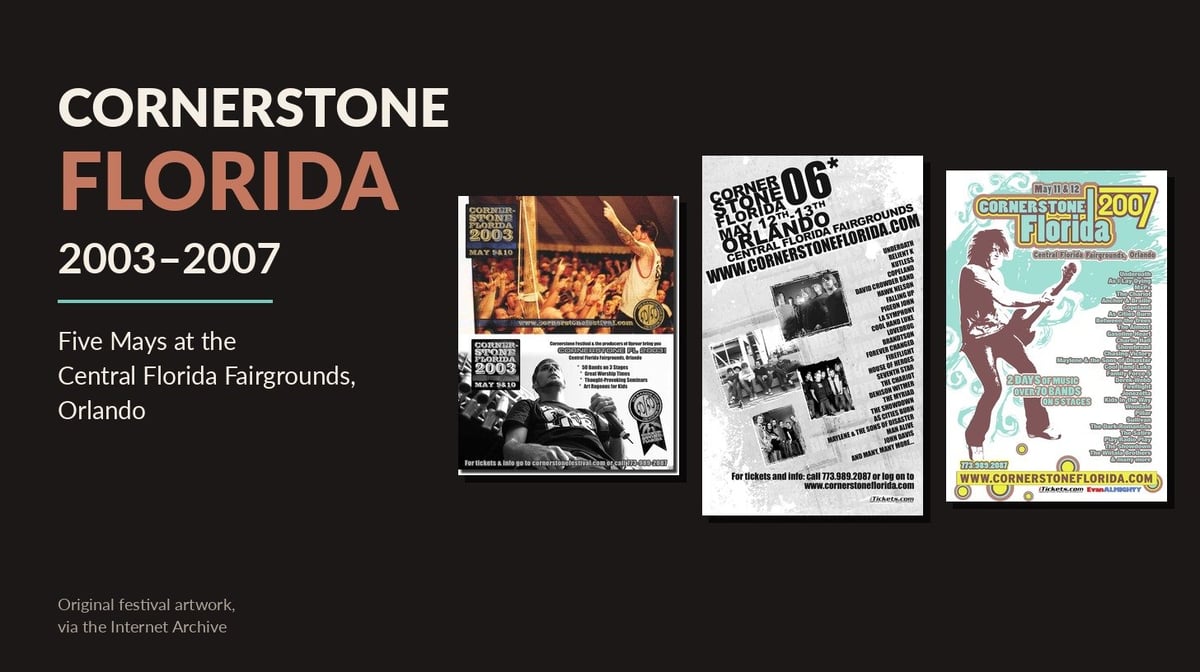
Cornerstone Florida ran every May from 2003 to 2007 (Wikipedia) at the Central Florida Fairgrounds, 4603 W. Colonial Drive in Orlando (Last.fm).
It lasted two days, Friday and Saturday, and brought many of the bands that made the Illinois festival famous to a county fairground in the Florida heat.
Not much of it survives online today.
What does survive lives largely in the Internet Archive, which saved copies of the festival's websites. That's where the posters, schedules and photos in this post come from.
Going back through those materials has been a wonderful trip down memory lane. Some of the names are familiar to anyone who followed Christian music during those years. Others were just getting started, long before anyone knew what they would become.
Here is how those five springs unfolded.
2003: Fifty Bands for Fifty Bucks
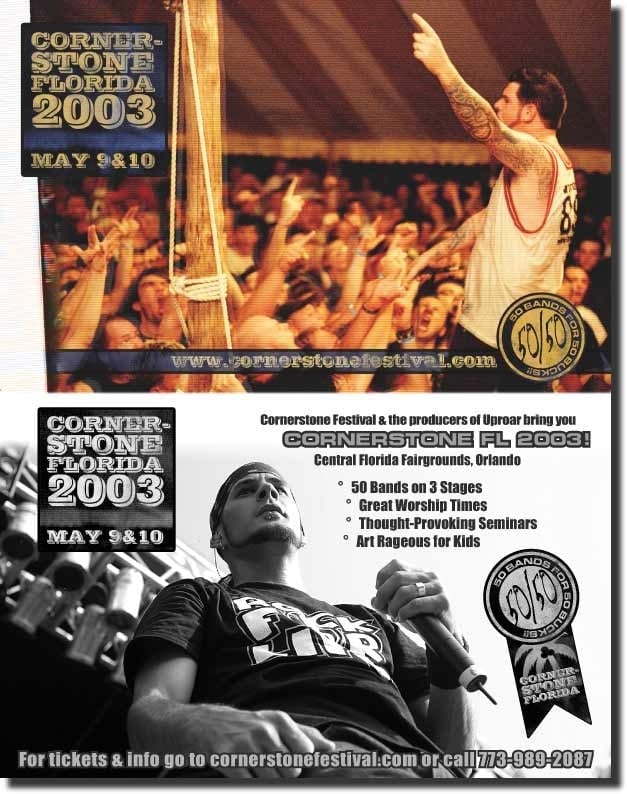
The first Cornerstone Florida took place May 9–10, 2003.
The flyer promised "50 Bands on 3 Stages," along with "Great Worship Times," "Thought-Provoking Seminars" and "Art Rageous for Kids."
Right there on the flyer was our credit as the producers of Uproar.
The ticket deal was simple: 50 bands for 50 bucks (original flyer).
Even now, that sounds like a pretty remarkable bargain.
The phone number on the flyer had a 773 area code, which is Chicago. It's a small detail, but one I appreciate. This really was a partnership between a Chicago community and three guys from Florida.
The final schedule shows the festival ended up a little bigger than promised.
Bands played on Stage 1, Stage 2, an Indoor Stage and a label showcase stage. On Saturday there was also an "Impromptu Stage" from 10 a.m. to 3 p.m.
Any ticket holder with a band could sign up on site for a shot at "Cornerstone glory" (2003 schedule).
I love that detail. There were established performers drawing crowds, but there was also room for somebody with a band and enough courage to put their name on a list.
Looking at that lineup today, it reads like a time capsule.
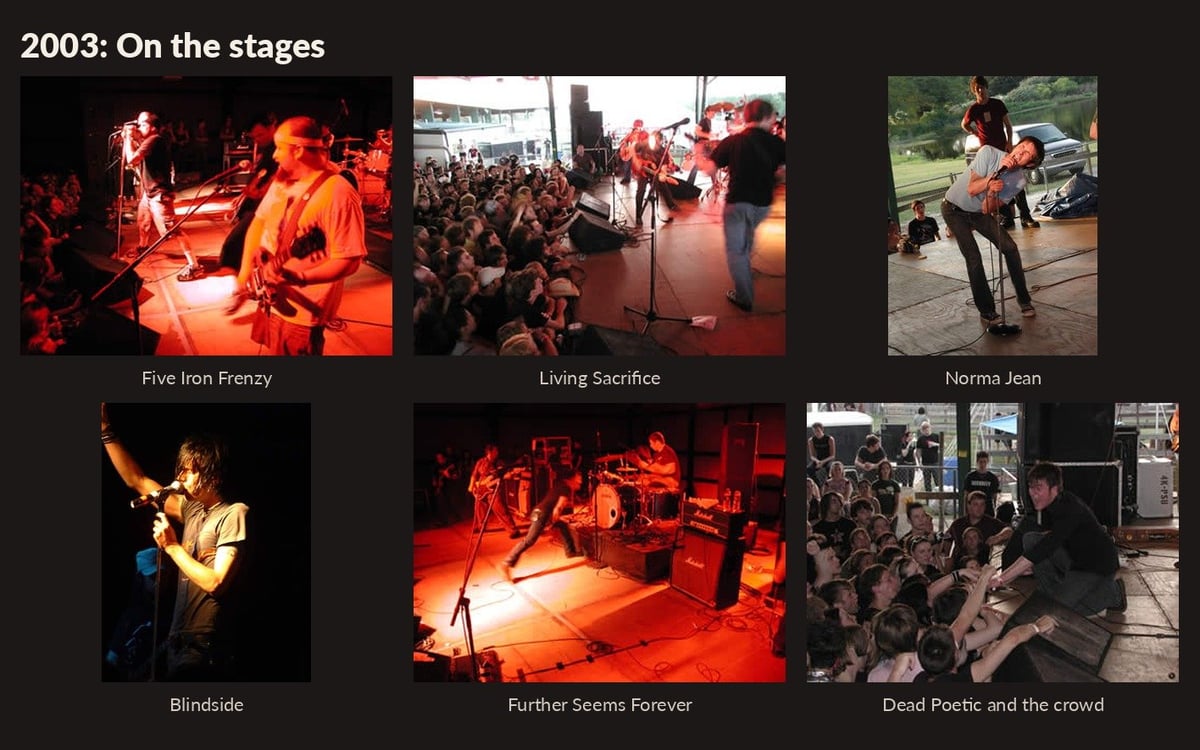
Friday night ended in the Indoor Stage with Over the Rhine at 8:30, Switchfoot at 10:00 and Five Iron Frenzy at 11:10.
Saturday was even stronger:
- Copeland at 1:00 p.m., one of the two bands Kyle managed.
- Anberlin at 4:00 p.m., Kyle's other band. They had formed only a year earlier in Winter Haven, just down the road in Polk County (Wikipedia).
- Underoath at 6:15 p.m. on Stage 2. The band started in Ocala and was based in Tampa (Wikipedia).
- Living Sacrifice and Blindside closing out Stage 2.
- Starflyer 59 and Squad Five-O on Stage 1.
- A late indoor run of The Violet Burning, Unwed Sailor, Ester Drang, Further Seems Forever and, at 11 p.m., Pedro the Lion.
And then there was the heat.
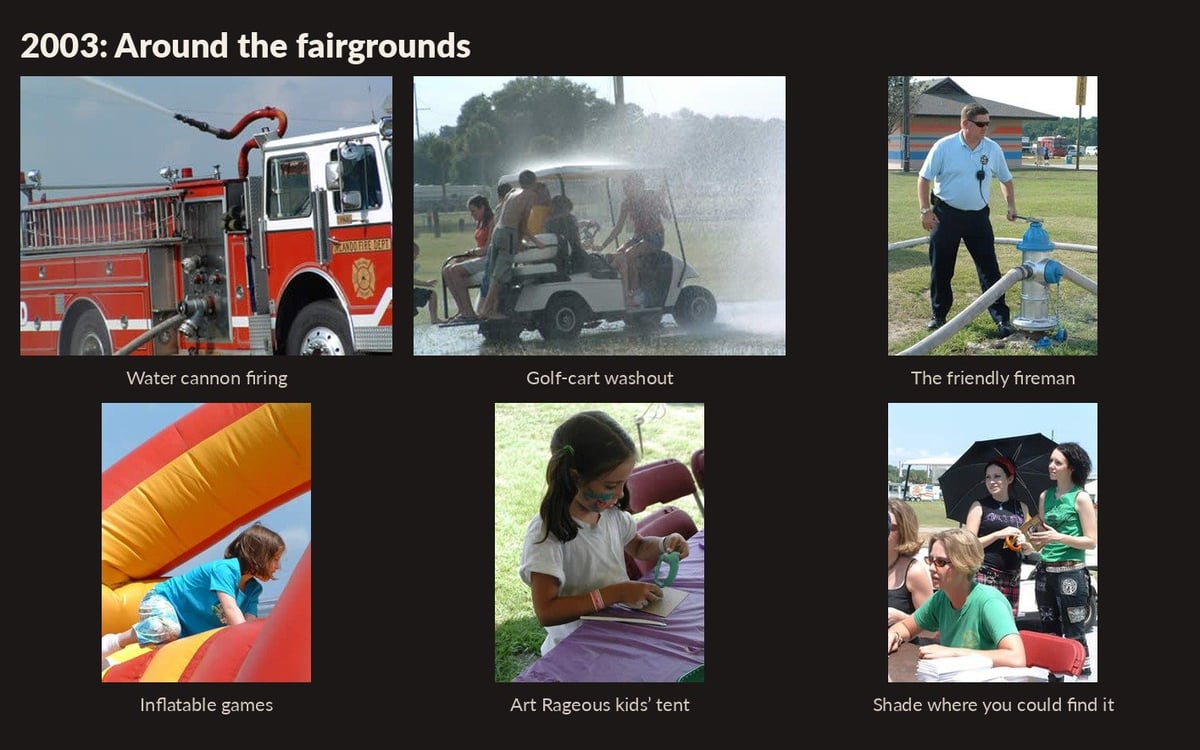
Anyone who has spent a May afternoon in Central Florida knows that an outdoor music festival comes with a few challenges that don't show up on the promotional posters.
The festival's own photo gallery tells that part of the story.
There are pictures of a fire truck spraying water over the fairgrounds, a golf cart getting soaked, kids on inflatable games and children at the Art Rageous craft tables.
One photo was simply titled "Praise God for Water" (festival photo gallery).
I think that pretty well captures it.
2004: The Big Names Arrive
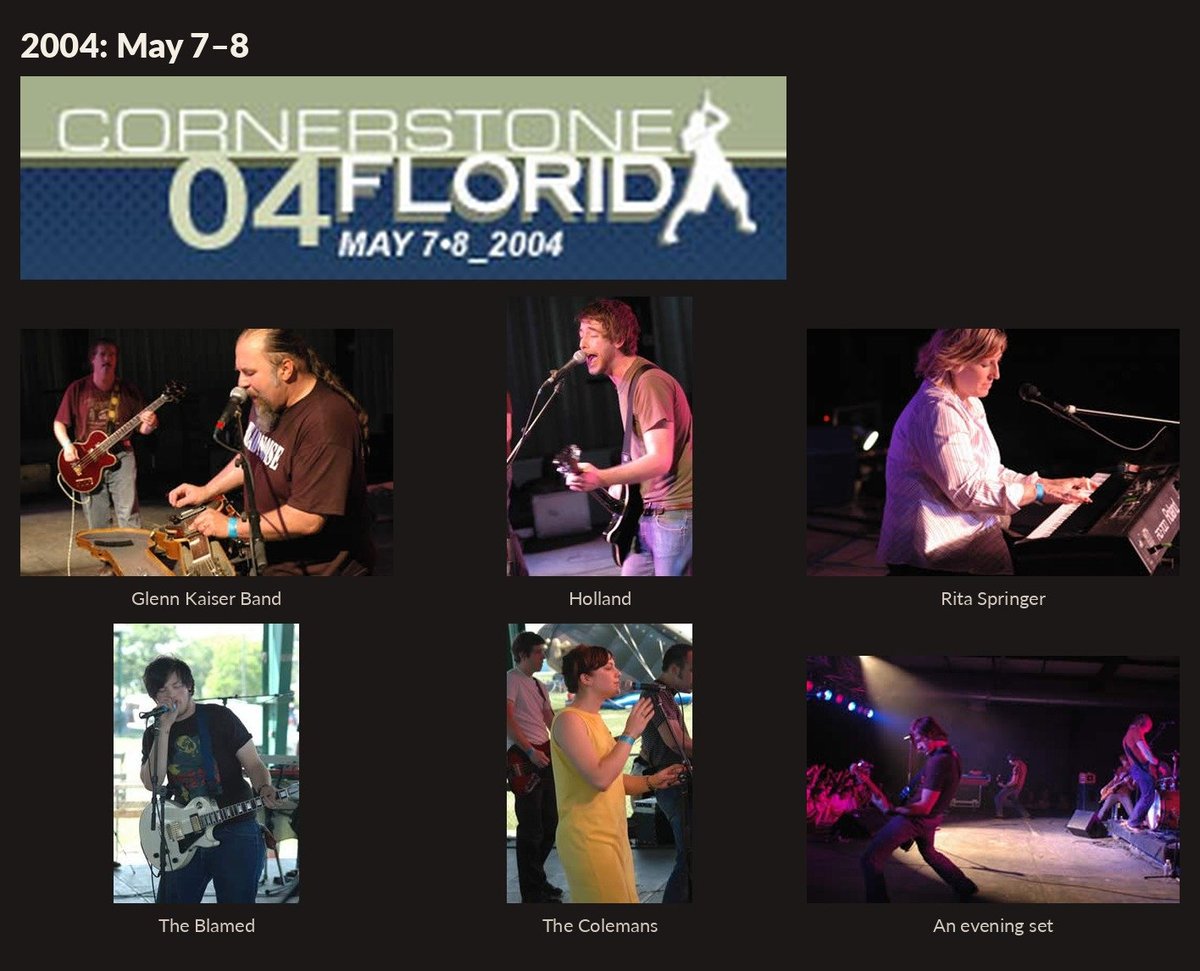
The second festival took place May 7–8, 2004, and looking back, it may have had the biggest collection of recognizable names of the entire five-year run.
Switchfoot came back, joined by Relient K, Chris Tomlin, Underoath, As I Lay Dying, Copeland, Norma Jean, Shane & Shane, Pillar, Further Seems Forever, Blindside, Over the Rhine, Starflyer 59 and The O.C. Supertones (Concert Archives).
That's quite a lineup for two days at the Central Florida Fairgrounds.
One of the things I enjoy about looking back at festivals like this is remembering that the people in the audience didn't know which bands would become household names or which songs they would still be listening to twenty years later.
They were simply there to hear music they loved.
For one young fan, that weekend stuck.
Writing years later, she remembered that the first time she saw Switchfoot was "at Cornerstone Florida 2004 I believe," when "Meant to Live" was "the anthem for every young adult" (Jesus Freak Hideout).
I suspect there are a lot of people who could tell similar stories.
Unfortunately, 2004 is also the year with the biggest hole in the public record.
The festival's website that year was built in Flash, and the official poster and schedule were never saved. What survives is a small banner ad and a handful of photos.
It's a reminder of how much of our relatively recent history can disappear when websites go away and nobody thinks to save what was there.
2005: The High-Water Mark
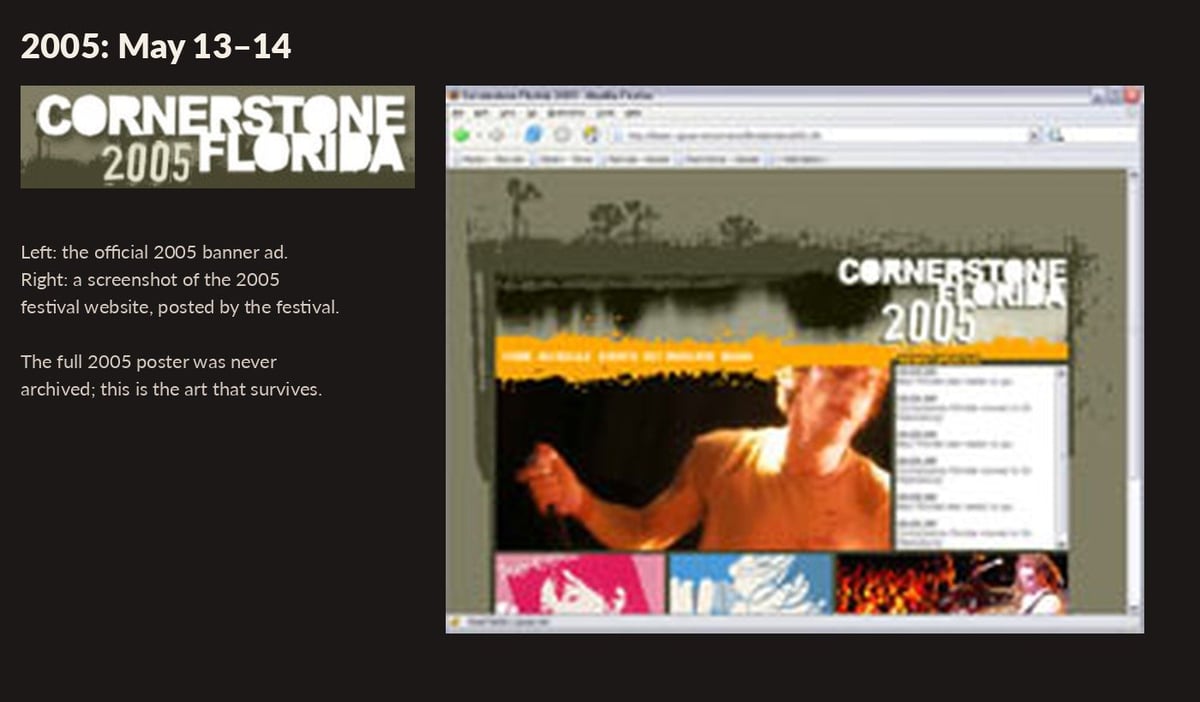
By May 13–14, 2005, Cornerstone Florida had grown into something much bigger than "50 bands on 3 stages."
The official schedule lists more than 100 acts across six stages: Stage 1, Stage 2, the Indoor Stage, the Masada-Prodigal Stage and two showcase stages for up-and-coming bands.
Gates opened at 1 p.m. Friday and 9 a.m. Saturday.
Seminar speakers included Jay Bakker, Glenn Kaiser and Tina Herrin, a JPUSA pastor and John Herrin's wife (2005 schedule; Cornerstone 2011 program).
WikiChristian reports that more than 10,000 people attended (WikiChristian).
Think about that for a moment.
What began with three Florida guys trying to bring a music festival south had become an event with more than a hundred acts and thousands of people gathering for a weekend in Orlando.
Saturday night was a run of headliners.
Underoath played Stage 1 at 8:45, Relient K played Stage 2 at 9:35, and the night ended with David Bazan, then mewithoutYou at 11:30 on the Indoor Stage.
But there's another name on that schedule that stands out today.
At 1:30 Saturday afternoon, on Stage 1, a young band called Paramore played.
Paramore.
It's fascinating to look back at a schedule like that and realize how many people were hearing a band before it became widely known.
One Tampa concert photographer later wrote that he went to "the Cornerstone Music Festival in Florida" in 2005 because a friend told him to catch a band with a female singer whose music was "just different."
He ended up "front and center," and "as the first song ended" he "was instantly hooked" (Shows I Go To).
That's one of the things live music can do.
You show up to hear somebody you've never heard of, and years later you still remember being there.
2006: Crowder, Relient K and a Return Visit from Paramore
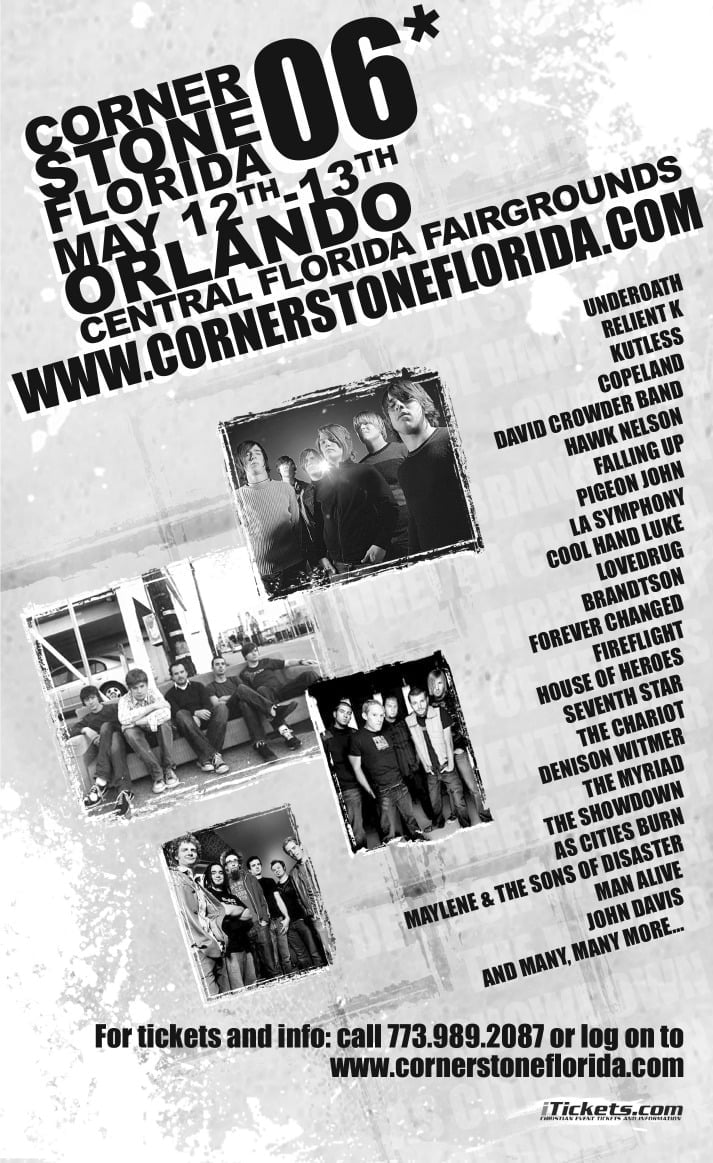
The 2006 festival took place May 12–13.
It had a bold black-and-white poster with an asterisk after the "06" (2006 postcard).
Friday night offered Kutless, Relient K and David Crowder Band on the outdoor stages, with Haste the Day and Project 86 closing the Indoor Stage.
Saturday ended with Copeland, Underoath and, at 11:30 p.m., Anberlin.
I particularly enjoy seeing Anberlin's name in that closing position.
Remember, Kyle Griner had been one of the three of us who made that first trip to Chicago, and Anberlin was one of the bands he managed.
Now, a few years later, the band was closing out Saturday night at Cornerstone Florida.
Paramore came back too, this time at 12:55 p.m. on Stage 2.
The two showcase stages were sponsored by Murray Hill Theatre and Outlet Records and held about 50 smaller bands (2006 schedule).
That combination of established performers and emerging bands was part of what made Cornerstone distinctive.
You could spend the evening watching a band you already loved and the afternoon discovering somebody new.
Sometimes the band you discovered in the afternoon turned out to be the one everybody was talking about a few years later.
2007: The Final Year
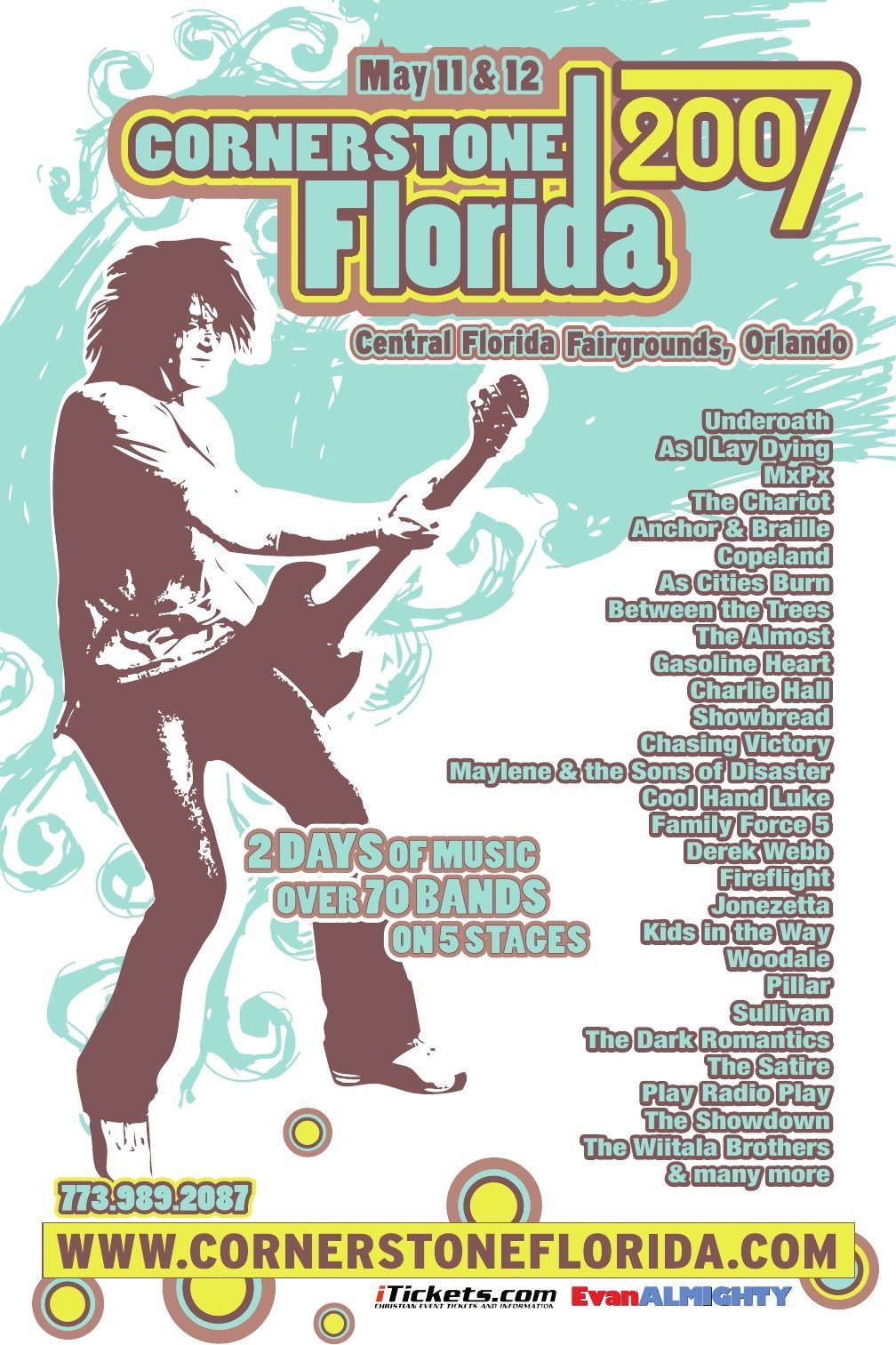
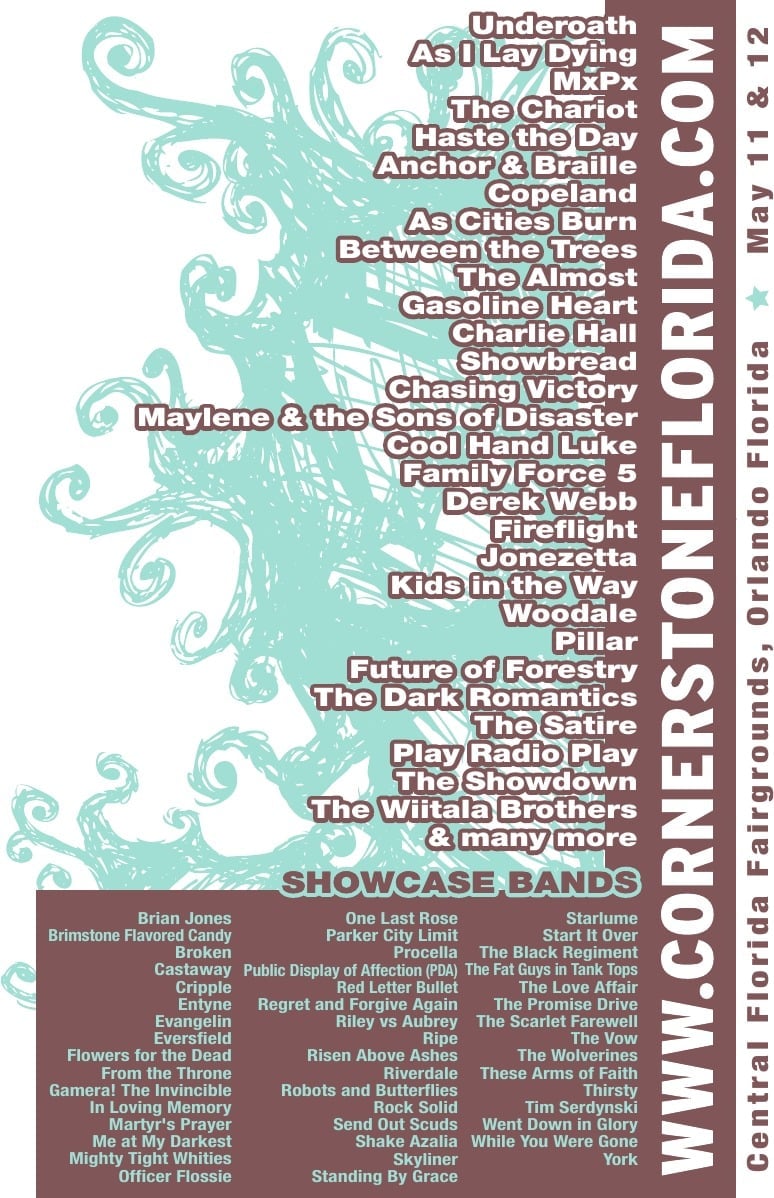
The last Cornerstone Florida took place May 11–12, 2007.
The poster promised "2 Days of Music, Over 70 Bands on 5 Stages."
Its sponsors were iTickets.com and the movie "Evan Almighty" (2007 poster).
Gates opened at 2 p.m. Friday and 10 a.m. Saturday.
Saturday was one of the heaviest nights the festival ever put on.
The Chariot and As I Lay Dying played Stage 1. Haste the Day, MxPx and Underoath played Stage 2.
Indoors, August Burns Red, Derek Webb, Charlie Hall and Cool Hand Luke played until 11:15 p.m. (2007 schedule).
And that was the end of Cornerstone Florida.
The 2008 festival was cancelled (Encyclopedia of Contemporary Christian Music), and Cornerstone Florida never came back.
The original Illinois festival continued for five more summers before ending in 2012 for budget reasons (Wikipedia).
It's interesting how something that once filled so much space on a calendar can eventually become a collection of old posters, photographs and memories.
For five years, though, Cornerstone Florida was very much alive.
And those five years were something special.
By the Numbers
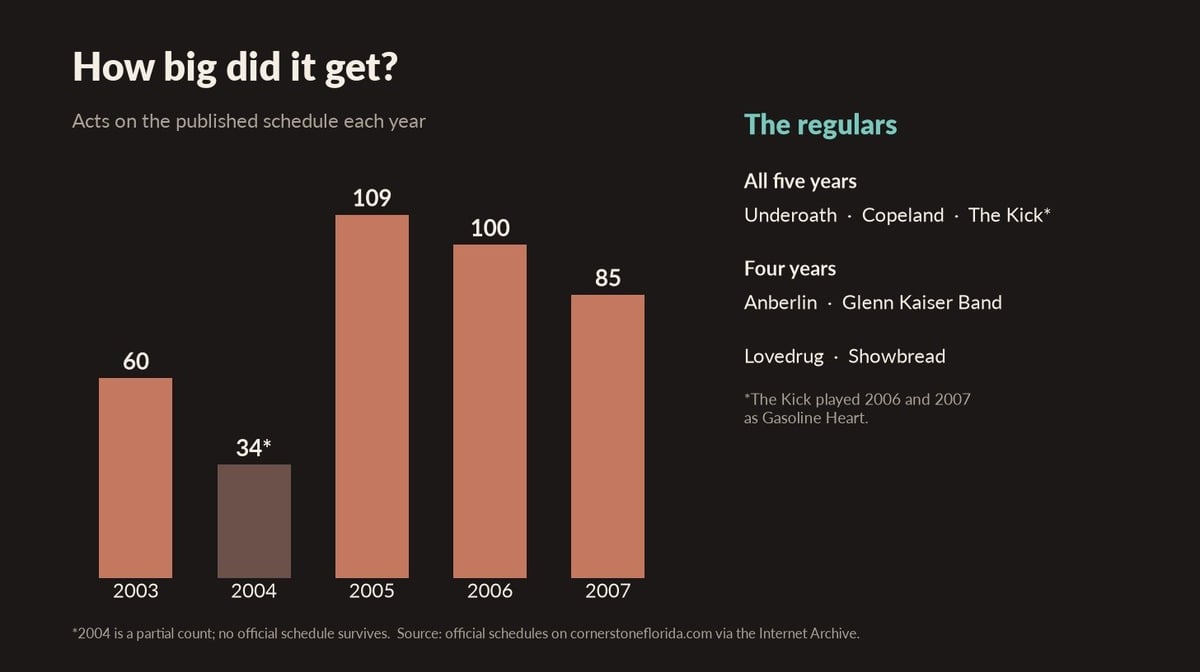
One of the things that surprised me as I worked through the archived schedules was how many bands returned year after year.
Across five festivals, a few became Cornerstone Florida regulars:
- Every year: Underoath and Copeland played all five festivals. The Kick did too, in a way. It played as The Kick from 2003 to 2005 and as Gasoline Heart in 2006 and 2007. The 2006 schedule even lists "Gasoline Heart (formerly The Kick)."
- Four years: Anberlin, Glenn Kaiser Band, Lovedrug and Showbread.
- Kyle's bands: Copeland played every year and Anberlin played four. By 2006, Anberlin was closing the whole festival at 11:30 p.m. on Saturday.
- Biggest year: 2005, with about 109 acts on the schedule.
Those numbers are impressive, but I think the more interesting part of the story is what they represent.
For five years, bands kept coming back, people kept buying tickets, and a music community that had been centered around a farm in Illinois had another place to gather in Central Florida.
Why It Still Matters
Cornerstone Florida was never as big as Bushnell, and it only lasted five springs.
But for a lot of young people in Orlando, Tampa, Lakeland and the towns in between, it was the one weekend a year when the Cornerstone world came to them.
It was a place to see Switchfoot before they were everywhere, to catch Anberlin when they were still a new Polk County band, and to stand in front of a stage for a group called Paramore.
It was also a very Florida festival.
Two hot days on a county fairground, with a fire truck soaking the crowd so the music could keep going.
Looking back at these old posters and schedules, I find myself thinking less about which bands played which stages and more about what it took to make those weekends happen.
Three guys in Florida had an idea. Some people in Chicago believed it was worth pursuing. And for five springs, thousands of people had a place to gather around music they loved.
I don't know how many friendships began on those fairgrounds, how many young musicians found inspiration watching someone perform, or how many people still remember a particular song from a particular Saturday night.
But I like knowing we helped make those moments possible.
I've spent much of my life working with young people, first in ministry and later in higher education. And one thing I've come to appreciate is that you don't always know which experiences will stay with someone.
Sometimes it's a conversation. Sometimes it's a friendship. Sometimes it's a song heard on a hot Saturday afternoon that becomes part of the soundtrack of a person's life.
We may never know which moments mattered most to the people who were there.
And maybe we don't need to.
I'm grateful to Albert and Kyle and to everyone at JPUSA who believed we could pull it off. I'm grateful for the bands that came, the people who bought tickets, and everyone who helped make those weekends happen.
And I'm grateful that someone, somewhere, saved those old websites so we could look back and remember.
Twenty years later, I'm still glad we tried.
If you were there, I'd love to hear what you remember. Which year did you attend? Who did you see? And somewhere in a drawer, do you still have that wristband?
Sources and image credits: The posters, flyers, banners, schedules and festival photos in this post were made by Cornerstone Florida and Jesus People USA. They come from the festival's archived websites at cornerstoneflorida.com and cornerstonefestival.com, preserved by the Internet Archive's Wayback Machine. Lineups for 2003, 2005, 2006 and 2007 come from the official schedules. The 2004 lineup comes from fan-contributed records at Concert Archives. Schedules were published "subject to change."